Understanding Leadership Motivations: Insights from Research
Leadership plays a vital role in shaping organisations and Fsocieties, but the motivations driving individuals to assume leadership roles remain a topic of ongoing exploration. Let's delve into the academic research surrounding leadership motivations, examining key theoretical models, historical developments, and practical implications.
The desire to lead varies greatly among individuals, influenced by personality traits, values, and experiences. Scholars have developed several models to explain these variations, each offering a unique perspective on the factors that inspire individuals to step into leadership roles. This post explores three prominent frameworks: the three-factor model of Motivation to Lead (MTL), the distal-proximal model of leadership, and the interplay between the Big Five and the Dark Triad traits in leadership emergence.
The study of leadership motivation first gained traction with Miner’s (1965) concept of "motivation to manage," which assessed individuals’ commitment to managerial roles. However, limitations in measurement techniques led to a shift in focus. The publication of Chan and Drasgow's (2001) three-factor MTL model marked a significant advancement, providing a nuanced understanding of leadership motivation.
Subsequent meta-analyses and theoretical developments, such as Badura et al.’s (2020) distal-proximal model, further integrated MTL into the broader leadership literature. These advancements highlighted the multidimensionality of MTL and its role as a mediator between personality traits and leadership outcomes.
The Three-Factor Model of Motivation to Lead
Leadership is not just about having the skills or authority to lead; it is also about the internal motivations that drive individuals to take on leadership roles. Recognising this, Chan and Drasgow (2001) developed the three-factor model of Motivation to Lead (MTL). This model explains the psychological reasons why some people feel compelled to lead, while others may shy away from such responsibilities. It breaks leadership motivation into three distinct types, each shaped by different values and thought processes:
- Affective-Identity Motivation to Lead
This type of motivation is rooted in enjoyment and a strong sense of identity as a leader. People with high Affective-Identity MTL feel intrinsically drawn to leadership roles because they genuinely enjoy leading and see themselves as natural leaders. For example, a student who consistently volunteers to lead group projects or a team member who takes the initiative in guiding colleagues does so because they find the act of leading fulfilling. This type of motivation often drives individuals to seek out leadership opportunities proactively, even when there is no external pressure to do so. - Social-Normative Motivation to Lead
Unlike affective-identity motivation, this form of leadership drive stems from a sense of duty or obligation. Individuals with high Social-Normative MTL believe that leading is the "right thing to do," whether due to cultural expectations, organisational norms, or a commitment to collective well-being. For instance, a family business heir may take up a leadership role because they feel it is their responsibility to continue the family legacy. Similarly, an employee might accept a managerial position because their team needs guidance, even if they would have preferred to stay in a non-leadership role. - Non-Calculative Motivation to Lead
This motivation reflects a willingness to lead even when it might not result in personal gain. People with high Non-Calculative MTL are less concerned about the costs of leadership, such as added responsibilities, time commitments, or personal sacrifices. They focus instead on the greater good, prioritising the success of their group or organisation over their own interests. For example, a teacher stepping into a department head role despite the extra workload, purely because they want to improve the school’s academic performance, is demonstrating this type of motivation.
The three-factor model helps us understand that leadership motivation is not a one-size-fits-all phenomenon. People take on leadership roles for different reasons—some because they enjoy it, some out of obligation, and others because they prioritise the group’s well-being over personal considerations. This framework challenges the stereotype that all leaders are inherently driven by power or ambition, highlighting instead that motivations are diverse and can also include selfless or duty-bound drivers. However, recent research also acknowledges that power and ambition may play a role in leadership motivations, particularly when examining dark personality traits in relation to MTL (Badura et al., 2020; Kennedy et al., 2021), which will be discussed later.
Understanding these motivations is particularly important for organisations, schools, and communities. By identifying which type of motivation drives a person, we can tailor leadership development programs, assign roles that align with their strengths, and support them in overcoming potential challenges.
Table 1. Characteristics and behaviours associated with each of the 3 Motivations to Lead.
Affective-Identity MTL | Social-Normative MTL | Non-Calculative MTL |
|
|
|
The Distal-Proximal Model of Leadership Motivation
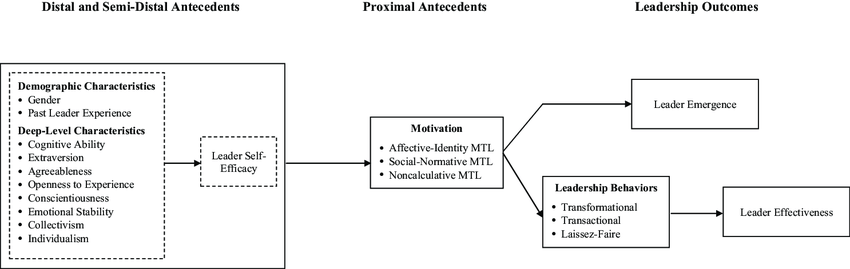
While the three-factor model explains the different types of motivation that drive people to lead, the distal-proximal model of leadership motivation, developed by Badura et al. (2020), takes this understanding one step further. This model explores how different factors—ranging from personality traits to life experiences—shape leadership behaviours and success. Importantly, it shows how these factors work through Motivation to Lead (MTL) as a critical bridge connecting personal characteristics to actual leadership outcomes.
To make this easier to understand, think of the model as a journey with three stages:
- Distal Predictors (The Starting Point)
Distal predictors are the foundational traits and experiences that influence a person's leadership potential. These include personality traits like extraversion (being outgoing and social), openness to experience (being creative and open-minded), and emotional intelligence (understanding and managing emotions effectively). Additionally, past experiences, such as opportunities to lead or observe good leaders, also act as distal predictors. These traits and experiences create a baseline for a person’s capacity and interest in leadership, even before they actively pursue leadership roles. - Proximal Mediators (The Bridge)
Proximal mediators, like Motivation to Lead, act as the connecting link between a person's foundational traits and their leadership behaviours. For instance, a highly extraverted person may not automatically become a leader. However, if they are motivated to lead (e.g., they enjoy leading or feel a sense of duty), this motivation turns their personality traits into action. In essence, MTL transforms potential into reality by bridging the gap between "who you are" and "what you do." - Leadership Outcomes (The Destination)
The final stage involves the tangible results of leadership motivation. These outcomes include behaviours like actively stepping into leadership roles, guiding and inspiring others (as seen in transformational leadership), and achieving success in leadership positions. For example, a person with strong emotional intelligence and a high motivation to lead might become an effective team leader, capable of resolving conflicts and fostering collaboration.
The distal-proximal model is crucial because it shows that leadership is not just a matter of personality or innate ability—it’s about how these traits are activated and channelled through motivation. For example, someone with the potential to lead may never take on leadership roles unless they are motivated to do so. Similarly, organisations can’t simply rely on hiring people with "leader-like" traits; they also need to nurture and encourage motivation to lead through training, mentorship, and supportive environments.
Imagine an employee who is highly intelligent and outgoing but lacks the motivation to take on leadership responsibilities. Without the proximal link of MTL, their leadership potential remains untapped. Conversely, someone with modest abilities but strong motivation to lead may outperform others because they are willing to work harder and persist in leadership challenges.
By combining distal predictors, proximal mediators, and leadership outcomes, the distal-proximal model offers a comprehensive understanding of how leadership potential becomes leadership success. It highlights the importance of Motivation to Lead as the key factor that turns traits and experiences into action.
Organisations can use this model to identify potential leaders, provide targeted development programs, and create environments that inspire leadership motivation. Whether it’s through training programs that enhance emotional intelligence or mentorship opportunities that build confidence, the distal-proximal model serves as a practical guide for turning leadership potential into reality.
Figure 1. Examples of Distal and Proximal antecedents, and Leadership Outcomes (Badura et at., 2020)
The Big Five and Dark Triad Traits in Leadership Motivation
Earlier, we explored how Motivation to Lead (MTL) can stem from different sources: enjoyment, duty, or selflessness. These motivations, however, do not exist in isolation. They are shaped by deeper personality traits that influence how individuals perceive leadership roles and their willingness to pursue them. To understand this connection, we turn to two key frameworks from psychology: the Big Five personality traits (Costa & McCrae, 1992; Goldberg, L. R.,1990) and the Dark Triad traits (Paulhus & Williams, 2002).
The Big Five personality traits are often referred to as the "bright side" of personality (Costa & McCrae, 1992; Goldberg, L. R.,1990). These traits - extraversion, openness, conscientiousness, agreeableness, and emotional stability, are generally associated with positive behaviours and outcomes (Badura et al., 2020) . Research shows that individuals high in these traits are more likely to develop strong leadership motivations (Badura et al., 2020).
For example:
- Extraversion makes individuals naturally drawn to leadership because they thrive in social situations and enjoy engaging with others (Judge & Bono, 2001) .
- Openness fosters creativity and a desire to embrace new challenges, often inspiring people to lead.
- Conscientiousness drives individuals to take responsibility and pursue goals, aligning with leadership as a means of organising and achieving success.
These traits align well with the motivations discussed earlier: extraverts may develop affective-identity MTL, enjoying the act of leading, while conscientious individuals may lean toward social-normative MTL, viewing leadership as a duty. Together, the Big Five traits provide a foundation for understanding why some people naturally emerge as leaders and embrace the challenges of leadership.
While the Big Five highlight the brighter side of leadership, the Dark Triad traits - narcissism, Machiavellianism, and psychopathy, reveal a more complex picture. These traits are often associated with self-serving and manipulative behaviours, but they can also drive certain leadership motivations in unexpected ways.
- Narcissism:
Narcissistic individuals have an inflated sense of self-importance and crave admiration. This often leads them to develop affective-identity MTL, as they enjoy the power and validation that leadership provides. They may also exhibit social-normative MTL, viewing leadership as a role they are entitled to fulfil. For instance, a narcissist might seek leadership not to serve others but to bolster their own status or control the narrative (Kennedy et al., 2021). - Machiavellianism:
People high in Machiavellianism are strategic and manipulative, often pursuing leadership as a means to achieve personal goals (Paulhus & Williams, 2002). Unlike affective-identity or social-normative motivations, their leadership drive is calculated and self-serving, focused on maximising benefits for themselves or their agenda. This aligns less with enjoying leadership or viewing it as a duty and more with seeing it as a tool for influence. - Psychopathy:
Psychopathy is marked by impulsivity, a lack of empathy, and a willingness to take risks. Its relationship with leadership motivation is complicated. On one hand, psychopathy can contribute to emergent leadership behaviours, such as taking bold actions in crisis situations. On the other hand, individuals high in psychopathy may struggle with non-calculative MTL because their lack of empathy undermines the selfless aspects of leadership (Badura et al., 2020).
The interplay between the bright Big Five traits and the darker Dark Triad traits highlights that leadership motivations can be both altruistic and self-serving (O'Boyle et al., 2012). For instance:
- Someone with high extraversion and narcissism may actively seek leadership roles because they enjoy leading and crave admiration.
- A highly conscientious but Machiavellian leader may embrace leadership out of a sense of duty but use it to pursue strategic, self-serving goals.
- An individual low in empathy (psychopathy) may emerge as a leader in certain contexts, such as during high-stakes decisions, but struggle in roles that require collaboration and emotional connection.
This nuanced understanding challenges the stereotype that all leadership motivations are virtuous. While traits like extraversion and conscientiousness often result in positive leadership outcomes, traits like narcissism and Machiavellianism introduce risks. A leader driven by power and ambition may perform well initially but could harm team morale or organisational trust over time.
Recognising the influence of both bright and dark personality traits on leadership motivation is essential for organisations. Leaders with high levels of extraversion, openness, and conscientiousness can inspire teams and foster innovation, while those with darker traits, such as narcissism or Machiavellianism, may require oversight to ensure ethical leadership. By understanding the interplay between these traits, organisations can make more informed decisions about leader selection and development. Ultimately, this dual perspective helps create a balanced view of leadership motivation—one that acknowledges both the potential and pitfalls of different personality traits in driving individuals to lead.
Understanding leadership motivations offers valuable practical applications for organisations. By recognising the diversity of MTL types, organisations can design targeted training programs that align with individual motivations. For instance, individuals with high affective-identity MTL are likely to benefit from transformational leadership training, which emphasises inspiring and motivating others, while those with high social-normative MTL may excel in roles that highlight responsibility and duty. Furthermore, leader selection processes should account for both the bright and dark sides of personality traits to ensure a balance between ambition and ethical leadership. Early development of a leader's role identity is equally crucial, as it fosters long-term leadership effectiveness. Experiential learning approaches, such as behavior modelling and mentorship, have proven particularly effective in cultivating MTL and instilling confidence in emerging leaders (Waldman et al., 2012).
Leadership motivations are a dynamic and multifaceted construct influenced by personality traits, social expectations, and experiences. The three-factor MTL model, the distal-proximal framework, and research on personality traits provide valuable insights into the drivers of leadership behavior. By integrating these findings into organisational practices, we can nurture effective and ethical leaders equipped to meet the challenges of the future.
Reference List:
- Chan, K.-Y., & Drasgow, F. (2001). Toward a theory of individual differences and leadership: Understanding the motivation to lead. Journal of Applied Psychology, 86(3), 481–498. https://doi.org/10.1037/0021-9010.86.3.481
- Costa, Paul & Mccrae, R.. (1992). Neo PI-R professional manual. Psychological Assessment Resources. 396.
- Badura, K.L., Grijalva, E., Galvin, B.M., Owens, B.P. and Joseph, D.L. (2020). Motivation to lead: A meta-analysis and distal-proximal model of motivation and leadership. Journal of Applied Psychology, 105(4), pp.331–354. doi:https://doi.org/10.1037/apl0000439.
- Goldberg, L.R. (1990). An Alternative ‘description of personality’: the Big-Five Factor structure.. Journal of Personality and Social Psychology, [online] 59(6), pp.1216–1229. doi:https://doi.org/10.1037/0022-3514.59.6.1216.
- Judge, T.A. and Bono, J.E. (2001). Relationship of core self-evaluations traits—self-esteem, generalized self-efficacy, locus of control, and emotional stability—with job satisfaction and job performance: A meta-analysis. Journal of Applied Psychology, 86(1), pp.80–92.
- Kennedy, J.C., Chan, K.Y., Ho, M.-H.R., Uy, M.A. and Chernyshenko, O.S. (2021). Motivation to Lead as Mediator of Relations Between the Dark Triad, Big Five, and Leadership Intention. Frontiers in Psychology, 12. doi:https://doi.org/10.3389/fpsyg.2021.675347.
- Paulhus, D.L. and Williams, K.M. (2002). The Dark Triad of personality: Narcissism, Machiavellianism, and Psychopathy. Journal of Research in Personality, [online] 36(6), pp.556–563. doi:https://doi.org/10.1016/s0092-6566(02)00505-6.
- Waldman, D.A., Galvin, B.M. and Walumbwa, F.O. (2012). The Development of Motivation to Lead and Leader Role Identity. Journal of Leadership & Organizational Studies, 20(2), pp.156–168. doi:https://doi.org/10.1177/1548051812457416.